About Us
Lorem ipsum dolor sit amet, consectetur adipiscing elit. Cras in fringilla turpis, eu consequat ante.

Donec Pellentesque
Donec Pellentesque
Keep Calm And Book Yourself A Holiday
Lorem ipsum dolor sit amet, consectetur adipiscing elit. Cras in fringilla turpis, eu consequat ante. Donec pellentesque, est non condimentum posuere, eros elit bibendum turpis, vel luctus elit erat in justo.

Keep Calm And Book
Yourself A Holiday
Lorem ipsum dolor sit amet, consectetur adipiscing elit. Cras in fringilla turpis, eu consequat ante. Donec pellentesque, est non condimentum posuere, eros elit bibendum turpis, vel luctus elit erat in justo. Integer ultrices dolor rutrum erat lacinia, ac tincidunt sapien viverra. Integer a ligula porttitor, porttitor nulla eu, laoreet erat. Etiam hendrerit consequat tellus. In ultrices porttitor luctus. Mauris at dolor id felis dictum commodo. Suspe
See Our Latest Blogs
Lorem ipsum dolor sit amet, consectetur
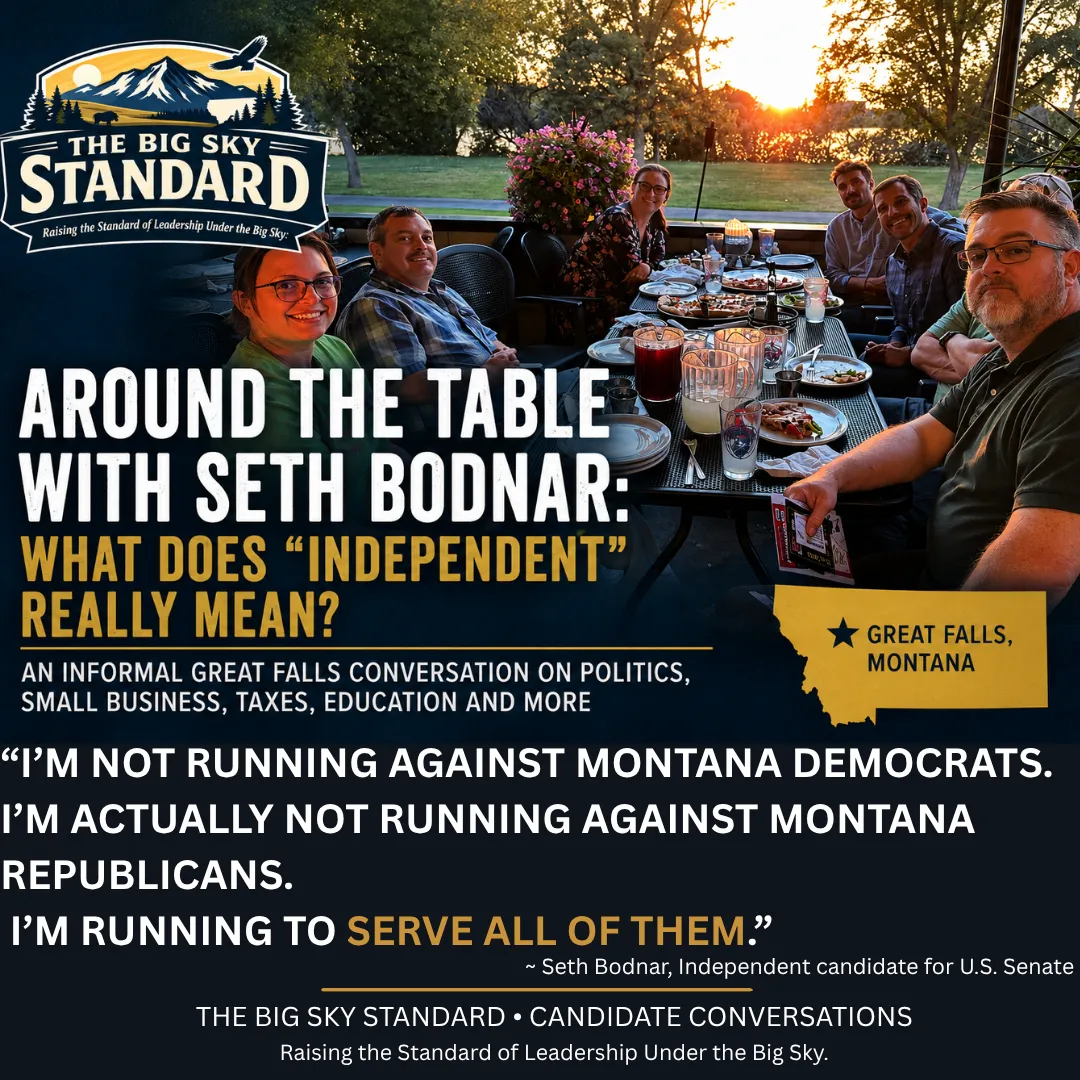
Around the Table with Seth Bodnar: What Does “Independent” Really Mean?
An informal Great Falls conversation with Montana U.S. Senate candidate Seth Bodnar offered an early look at how he views party politics, small business, taxes, education, criminal justice, data centers and what it means to run as an independent.
There is something different about political conversations when they happen around a restaurant table instead of behind a podium.
Thursday evening, a small group of candidates and community members gathered at MacKenzie River Pizza in Great Falls for an informal question-and-answer session with Seth Bodnar, an independent candidate for the U.S. Senate from Montana.
There were no prepared speeches.
People ate pizza, moved in and out of the conversation and asked questions about issues they cared about personally. Some were political. Others came from lived experience.
ForThe Big Sky Standard, this wasn't intended to be the full interview with Bodnar. That will come later.
Instead, much like my recent conversation with congressional candidate Mike Eisenhauer, this was an opportunity to sit across the table from a candidate, ask some questions and hear how he responds when the conversation isn't completely scripted.
And one question in particular was one I wanted answered.
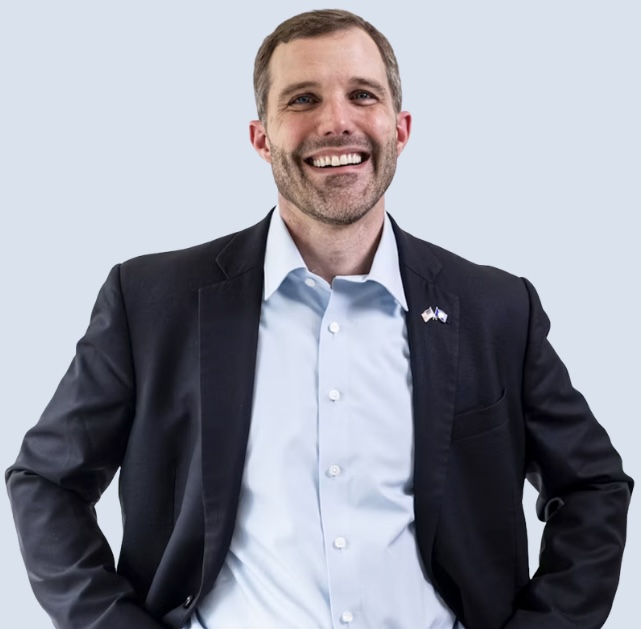
If You're an Independent, What Happens in Washington?
I have been asking independent candidates a fairly straightforward question:
When you get to Washington, who are you going to caucus with?
To me, that matters.
There are politicians who run under the independent label but then caucus consistently with one political party. If that is going to happen, voters deserve to know it before Election Day.
So I asked Bodnar directly.
He acknowledged that Democrats, Republicans and independents are supporting his campaign. He pointed to support from people with Republican backgrounds as well as Democrats and independents.
But then he made the distinction I was looking for.
Bodnar said he doesnotintend to caucus with either major party.
Instead, he said he wants to help build an independent voting bloc involving senators willing to work across party lines.
“Neither party has a monopoly on good ideas.”
His argument was that Montana's senator should work with Republicans when their proposal makes sense for Montana, work with Democrats when theirs does and be willing to oppose either party when necessary.
That led to perhaps the clearest statement of the evening.
Bodnar said:
“I'm not running against Montana Democrats. I'm actually not running against Montana Republicans. I'm running to serve all of them. But I'm running against a national system and two national parties that aren't doing right by Montana.”
That distinction deserves further discussion during our full interview.
Bodnar repeatedly separatedMontana Republicans and Democratsfrom their national party organizations.
His contention is that national Democrats have neglected rural states such as Montana while national Republicans increasingly assume Montana voters will support their nominees regardless of what happens inside the party.
In his view, that leaves Montana caught between two national organizations that either take the state for granted or don't pay enough attention to it.
His pitch is that an independent senator could change that equation.
“Explain Your Vote”
Another issue that matters to me personally is accountability after the election.
I told Bodnar that I don't expect to agree with every vote an elected official makes.
What I do expect is for that elected official to be able to come home, sit across the table from the people they represent and explain it.
I've had conversations with politicians where I disagreed with their decision but respected them because they explained their reasoning.
I've also experienced the opposite — asking a legitimate question about a vote and being attacked simply for asking.
So I asked Bodnar whether he would be willing to explain his votes to Montanans, even when those votes were unpopular.
His answer was simple:
Yes.
Bodnar said he has made a commitment to explain every vote he takes.
The discussion then turned toward massive congressional bills stretching hundreds or even thousands of pages.
Several people questioned whether lawmakers can realistically understand everything buried inside legislation that large.
One person asked whether Congress should break legislation into smaller, more understandable bills rather than combining unrelated provisions and riders into enormous packages.
Bodnar agreed that government needs greater transparency and that legislation should be understandable to the public.
It is another subject worth exploring much deeper when we sit down for the full interview.
Small Business, Tariffs and the Cost of Living
The conversation also moved into an issue almost everyone at the table could relate to:
People are working harder, but many don't feel like they are getting ahead.
Housing costs came up.
Taxes came up.
Healthcare came up.
So did wages.
Bodnar said he believes the federal minimum wage should be increased, while acknowledging that relatively few Montana employers currently pay only the federal minimum.
The broader question, however, became less about minimum wage and more about what is happening to working- and middle-class families.
People around the table shared examples of earning more money only to watch taxes and expenses consume much of the increase.
That moved naturally into small business.
Bodnar argued that many Montana businesses are being squeezed by higher input costs, healthcare expenses and trade policies.
Tariffs became an important part of the discussion.
His position was not that tariffs should never be used.
He said they can be legitimate strategic tools when used to protect national security or important domestic industries.
His criticism is how broadly and unpredictably they can be applied.
For Montana — particularly because of its relationship with Canada — Bodnar argued that an unnecessary trade fight can hurt tourism, agriculture and local businesses.
That raises a bigger question I plan to ask during the full interview:
How do we actually bring manufacturing and business back to America without making it harder for American small businesses to survive in the process?
Unions: Does It Always Have to Be a Fight?
The evening actually began with a conversation about unions.
Those who have followed my writing know I recently looked closely at a labor dispute involving a Great Falls grocery store. That made this part of the conversation particularly interesting to me.
Bodnar discussed his belief that management and unions do not inherently have to be enemies. Whether it is a small business, university or other organization, he said he believes healthy partnerships between employees, organized labor and management are possible.
But there was an important piece of context I wanted to address.
During our conversation, it became clear that Bodnar had met with representatives of the union involved in the Great Falls grocery-store dispute, but he hadnot yet sat down with the owner of the business.
That matters to me.
If we're going to talk about supporting workersandsupporting Montana's small businesses, then I believe we need to be willing to hear both sides before reaching conclusions about a dispute.
I shared with Bodnar that after looking further into this particular situation, I found there was considerably more to the story than what I initially heard. I have spoken with people connected to the issue, including individuals with union experience, and heard concerns that deserve to be part of the conversation as well.
Bodnar acknowledged that he had not heard the owner's side.
So I offered to help change that.
I told him I would be willing to serve as the conduit and arrange a conversation between Bodnar and the grocery-store owner when he is back in Great Falls.
I think that meeting could be valuable.
Bodnar says he believes unions and management should be able to sit across the table from one another and develop healthy working relationships. He also talks frequently about the importance of Montana's small businesses.
This is an opportunity to put both of those principles into practice.
It doesn't require Bodnar to agree with the owner.
It doesn't require the owner to agree with the union.
It simply meanshearing both sides before deciding what happened and where responsibility belongs.
That's the kind of conversation The Big Sky Standard should encourage.
Not choosing the conclusion first and then finding the evidence to support it.
Bring people to the table. Ask the questions. Hear both sides. Then let the facts take us where they take us.
Criminal Justice Became Personal
One of the most compelling portions of the evening came when another candidate at the table asked Bodnar about criminal justice reform.
For her, the issue wasn't theoretical.
She explained that her brother is currently incarcerated and has been transferred out of Montana — first to Arizona and later Mississippi.
She described the difficulty of maintaining family connections, increasing communication costs, inadequate programming and concerns that inmates sometimes cannot meet parole requirements because required programs aren't available.
Her question centered on the privatization of corrections.
Bodnar responded that incarceration should not become an industry where financial success depends upon keeping prison beds full.
He described that as creating the wrong incentive.
He was equally clear that criminal justice reform does not mean ignoring crime.
Instead, the conversation focused on rehabilitation, education, job training, mental health services and ultimately reducing recidivism.
The objective, Bodnar said, should be fewer people returning to prison and more people becoming productive members of society.
The discussion then moved toward prevention.
Education.
Employment opportunities.
Mental and physical healthcare.
All of the things that can influence someone's path long before they enter the criminal justice system.
Education and Opportunity
Education is an area where Bodnar naturally spent considerable time.
As the former president of the University of Montana, it is familiar territory.
He talked about his belief that higher education shouldn't measure its success by how many students it rejects.
Instead, he argued that Montana's universities should create pathways for students willing to work.
Bodnar discussed theGrizzly Promise, an initiative developed during his time at UM aimed at making tuition accessible to qualifying Montana students from lower-income households.
The larger philosophy behind it came through repeatedly during the conversation:
Opportunity shouldn't depend entirely on where someone was born, who their parents are or how wealthy their family happens to be.
But opportunity, he emphasized, doesn't remove personal responsibility.
People still have to show up.
They still have to work.
They still have to perform.
The role of education, in his view, is opening the door.
The individual still has to walk through it.
Montana Food Feeding Montana
Agriculture also entered the conversation in an interesting way.
Bodnar cited a striking change in Montana's food system.
He said that decades ago a significantly larger percentage of the food Montanans consumed was grown or produced inside Montana. Today, that percentage is dramatically smaller.
That led to a discussion about consolidation in agriculture, particularly meat processing.
Bodnar argued that Montana ranchers produce premium products but frequently have to ship those products outside the state for processing before food eventually makes its way back to consumers.
He supports stronger antitrust enforcement and renewed country-of-origin labeling so consumers know where their food comes from.
It is an economic issue, but also a food security and local-control issue.
And it deserves a deeper conversation.
Data Centers: Community First
Near the end of the evening, another candidate asked Bodnar about an issue receiving increasing attention across Montana:
Large data centers.
The question centered around electricity usage, water, infrastructure and whether ordinary Montana ratepayers could ultimately shoulder the costs created by massive industrial developments.
Bodnar said he is opposed to developments being imposed on Montana communities without meaningful local involvement.
His standard, he said, applies beyond data centers.
He opposes projects that threaten Montana's water, wildlife, habitat or way of life without adequate community involvement.
On data centers specifically, he said he would oppose projects that drive utility costs higher for Montana families while primarily benefiting large out-of-state companies.
He also connected the issue to artificial intelligence.
Bodnar said AI needs stronger guardrails covering areas including children, workers and critical infrastructure, and called for security reviews as increasingly powerful AI models are developed.
That opens up an entirely separate series of questions for the full interview.
A Different Kind of Political Conversation
Perhaps what stood out most wasn't any single policy answer.
It was the format.
Candidates and community members were sitting around a table challenging a candidate directly.
There were Democrats in the conversation.
There were independents.
There were people who have supported Republicans.
Nobody was required to agree.
And nobody needed a campaign commercial to tell them what happened.
They could ask.
That is exactly the type of conversation I wantThe Big Sky Standardto continue creating.
Not “gotcha” journalism.
Not campaign promotion.
Not deciding for readers which candidate deserves their vote.
Ask the questions.
Press when an answer needs clarification.
Then let the candidate explain their position in their own words.
For me, one of the biggest unanswered questions surrounding Seth Bodnar's campaign has been the independent label.
Would “independent” simply become another vote inside an established Democratic or Republican caucus once he reached Washington?
His answer Thursday night was no.
He says he wants to remain outside both caucuses and work toward a coalition of lawmakers willing to vote together when their interests and ideas align.
Now comes the next step.
The Big Sky Standard will be inviting Seth Bodnar to sit down for a full interview where we can go deeper into his positions, his record, the criticisms being made against him, the money behind the race and exactly what an independent U.S. senator from Montana would look like once the campaign ends and governing begins.
Because running as an independent is one thing.
Governing independently is the real test.
Editor’s note: This article is based on an informal group conversation and Q&A with Seth Bodnar in Great Falls. Portions of the conversation have been condensed and lightly edited for clarity. A formal Big Sky Standard candidate interview is planned.
Hear From Our Clients
Lorem ipsum dolor sit amet, consectetur adipiscing elit.

George Owens

Lorem ipsum dolor sit amet, consectetur adipiscing elit. Quisque nisi nunc, tincidunt non nibh non, ullamcorper facilisis lectus. Sed accumsan metus viverra turpis faucibus, id elementum tellus suscipit.

Max Tanner
Lorem ipsum dolor sit amet, consectetur adipiscing elit. Quisque nisi nunc, tincidunt non nibh non, ullamcorper facilisis lectus. Sed accumsan metus viverra turpis faucibus, id elementum tellus suscipit.

Kim Wexler
Lorem ipsum dolor sit amet, consectetur adipiscing elit. Quisque nisi nunc, tincidunt non nibh non, ullamcorper facilisis lectus. Sed accumsan metus viverra turpis faucibus, id elementum tellus suscipit.

Billy Jackson
Lorem ipsum dolor sit amet, consectetur adipiscing elit. Quisque nisi nunc, tincidunt non nibh non, ullamcorper facilisis lectus. Sed accumsan metus viverra turpis faucibus, id elementum tellus suscipit.

© 2022 Company Name - All Rights Reserved, consectetur adipiscing elit. Maecenas commodo suscipit tortor, vel tristique sapien